New Delhi 17 Oct 2026: The ₹36,441-crore sports outlay for the 20230 Commonwealth Games alongwith the push on golf tourism, natural turf is emerging as key sporting infrastructure. India's geographical location, it’s climate and state of the water resources is making the country look for innovative methods to maintain smarter water-efficient turf.
When Ahmedabad was confirmed last November as host of the 2030 Commonwealth Games, it marked another step in India's journey towards hosting the Olympics in 2036. Behind every stadium, academy and golf course on that journey is a less visible asset that is now coming into its own: the natural grass the games are played on.
Turf management is fast emerging as a specialised, technology-led profession in India, and as one of the most promising growth markets for the global turf industry.
India is projected to be the fastest-growing major market for sports turf sensors over the next decade, expanding at 13.2 per cent a year until 2036. That is ahead of China and well above the global rate of 10.3 per cent, according to Future Market Insights. The wider global turf protection market, led by companies such as Syngenta, Bayer, BASF and Corteva, was worth USD 6.38 billion in 2025 and is expected to reach USD 10.58 billion by 2034, according to Fortune Business Insights. North America accounts for nearly 40 per cent of that market today, while India, at about USD 180 million, is at an early stage with significant room to grow.
Global players are already acting on that potential. This month's USD 4 million DP World India Championship at Delhi Golf Club, the largest prize fund the DP World Tour has offered for an event in India, has drawn a field that includes Rory McIlroy and defending champion Tommy Fleetwood. In cricket, UK-based SIS Grass has invested in bringing its hybrid-pitch technology to India after the International Cricket Council allowed hybrid surfaces in T20 and one-day matches, beginning with the HPCA Stadium in Dharamshala.
Policy is adding momentum. The Union Cabinet has approved a combined outlay of ₹36,441 crore for an expanded Khelo India scheme and support for national sports federations from 2026-27 to 2030-31. In April, at the launch of the Indian Golf Premier League, Union Tourism Minister Gajendra Singh Shekhawat said golf tourism "attracts high-value visitors and drives long-term economic growth", and that India has the potential to emerge as a leading destination in the segment. The league has committed to mobilising USD 2 billion for golf tourism infrastructure, including in tier-2 and tier-3 cities.
India's climate is also turning the country into a proving ground for smarter turf care. Courses and grounds here have to stay at their best through summer heat that touched 47.2 degrees Celsius in Vidarbha this May, a cold northern winter and the transition weeks in between. The national water picture is improving: India's overall stage of groundwater extraction has eased from 63.33 per cent in 2017 to 60.63 per cent, the government told Parliament in July. With 730 of 6,762 assessment units still classed as over-exploited, though, water efficiency remains a priority for every turf manager.
This is speeding up the shift to precision irrigation, soil-moisture monitoring, heat-tolerant grass varieties and multi-function machines that do more with smaller crews. These are the same technologies that are driving the sensor and turf protection markets worldwide.
"India will soon host the world's athletes and golfers on its own grass, and that grass performs in conditions few other countries face," said Wg. Cdr. Arun K. Singh, President of the Golf Course Superintendents & Managers Association of India (GCS&MAI). "Global companies clearly see India's potential. Our opportunity is to build Indian expertise that meets world standards with less water and at lower cost. If we get this right, India will not just import turf knowledge. It will set the benchmark for managing grass in a hotter, drier world."
Vinod Goyal, Secretary General of GCS&MAI, described turf as an economic asset. "A well-kept course or sports ground brings tournaments, tourists, property value and jobs, and it deserves to be managed like any other infrastructure," he said. "Turf care in India is moving from experience to diagnosis. Our superintendents are using soil science, grass selection and the right machinery to solve problems at the root, and that saves both water and money."
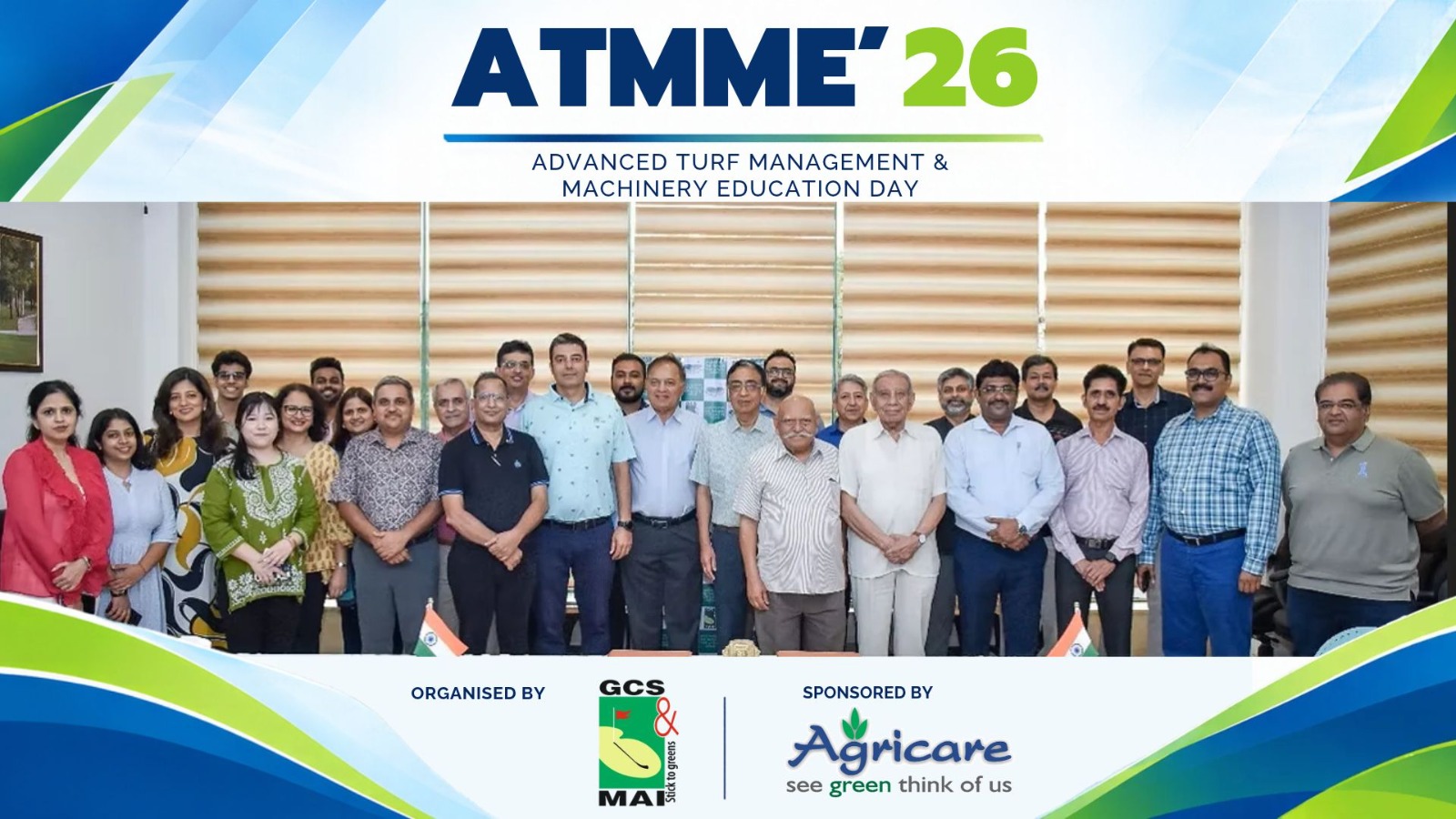
Col. Ravi Rana, Vice President, GCS&MAI, said, “ATMME ’26 will promote practical learning and modern, sustainable turf management practices through expert insights and live demonstrations.”
Rakesh Sharma, Additional Vice President, GCS&MAI, said, “The programme will help turf professionals enhance maintenance practices, optimise resources and improve playing surface quality.”
Taking this conversation forward, leading turf, irrigation, agronomy and machinery experts from India, the UK, the USA and Japan will gather at Noida Golf Course on October 24 for a technical programme convened by GCS&MAI. They will share practical approaches to water-efficient irrigation, seasonal turf management and the mechanisation of course maintenance in Indian conditions.
As India prepares to welcome the world to its stadiums and fairways, the grass beneath them is set to become one of the quiet success stories of its sporting growth. It will be built on science, skilled people and smarter use of every drop of water.
About GCS&MAI: The Golf Course Superintendents & Managers Association of India (GCS&MAI) is the professional body for the people who build, manage and maintain India’s golf courses and sports turf. The association works to raise standards of golf course management through technical education, knowledge sharing and sustainable turf practices. Its initiatives include a Greenkeepers Certification Course, launched in 2023 with ILead and the Kolkata-based Champ for Life Academy, and SUSTAIN, its seminar series on sustainable turf and irrigation practices. By bringing together superintendents, greenkeepers, agronomists and industry partners from India and abroad, GCS&MAI helps Indian courses and grounds meet international standards. More at www.gcsmai.com.